The Farewell Ledger
Book Club Kit
The Farewell Ledger
Stories of Money, Family, and Adinkra
Elijah Asare
Author · Financial analyst · Investor · Educator
A free guide for book clubs, reading circles & families · elijahasare.com
Welcome to the table
Pull up a chair.
Thank you for choosing The Farewell Ledger for your group. This is a novel in eighteen stories, and it was written to be talked about: slowly, honestly, and with the people you love.
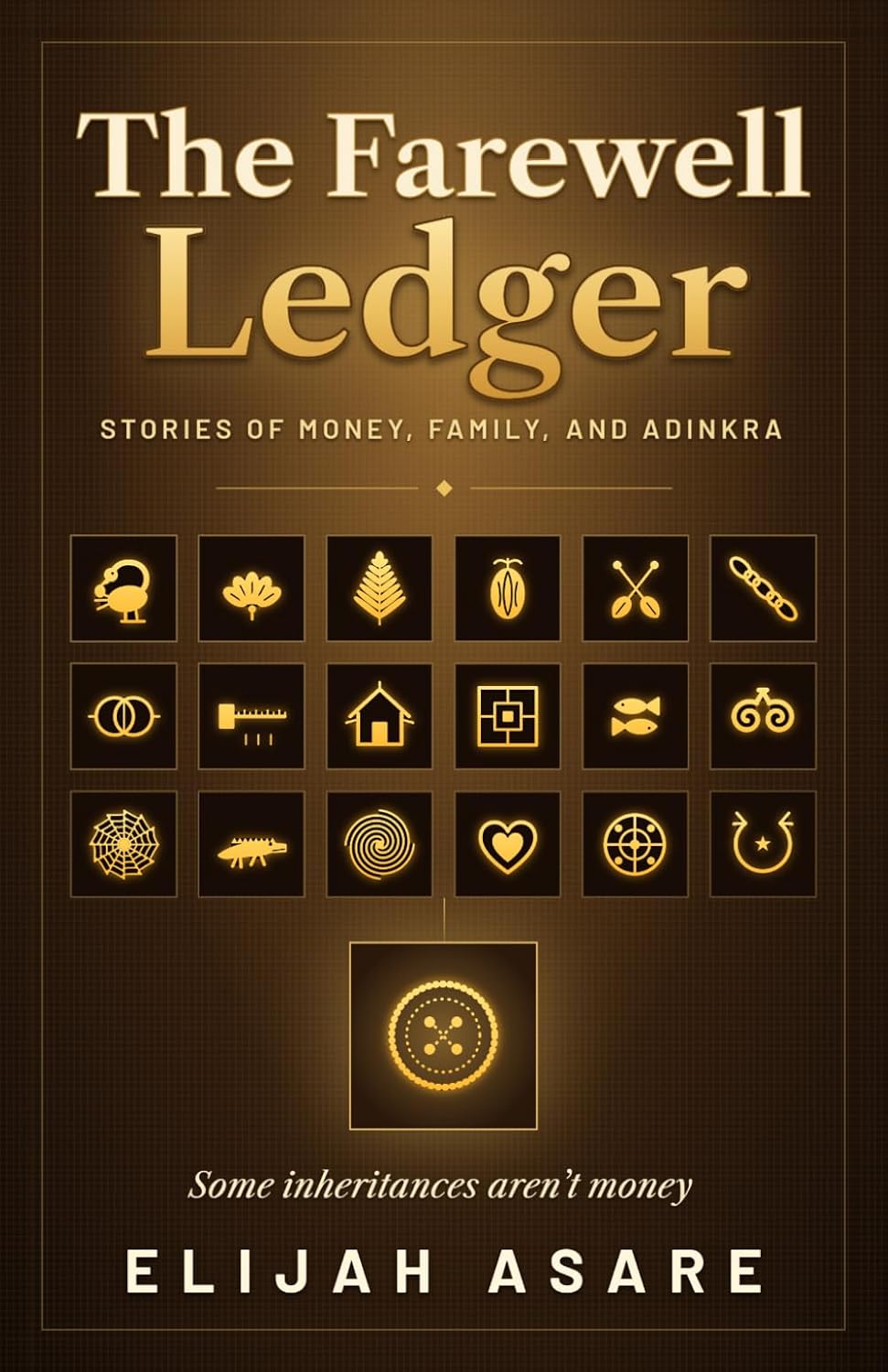
When her aunt Adwoa dies in Kumasi, Ghana, Abena Kwarteng, a hospital billing clerk in America, inherits no money. Instead she receives an adinkra cloth stamped with eighteen symbols, a box of handwritten ledgers, and one rule: read one story a month, and don’t skip ahead. Each symbol opens a story, and each story carries its wisdom into a real money decision, closing with “On the Ledger” lessons on saving, debt, insurance, fraud, wills and more.
Inside this kit
- 1Welcome & how to use this kit2
- 2Fifteen questions for the whole book3
- 3Story conversations5
- 4The monthly ledger: prompts for any story5
- 5Reading the cloth: adinkra prompts6
- 6Dinner-table money questions6
- 7About the author & where to buy7
How to use this kit
- Honor Aunt Adwoa’s rule. One story a month, no skipping ahead. Eighteen stories make an eighteen-month reading year.
- Open with the symbol. Begin with the story’s adinkra symbol and its meaning, then the plot.
- Close with “On the Ledger.” End with the money lesson and one small step for the month ahead.
- Keep your own ledger. One line a month in a notebook: what the story stirred up about money at home.
Suggested pacing
| Your rhythm | What to read | Meeting focus |
|---|
| Monthly (recommended) | One story per meeting, in order, over eighteen months | Story conversation + monthly ledger prompts |
| Every other month | Two or three stories per meeting, still in order | Pick one story to go deep; touch the others lightly |
| A single evening | The whole book, read at your own pace | Whole-book questions + dinner-table questions |
However you pace it, read in order. The ledgers were written to be opened one at a time.
Section 2
Fifteen questions for the whole book
Use these at any point in the reading year, or save them for a closing meeting after the eighteenth story.
◆
- InheritanceAunt Adwoa leaves no money, only a cloth, a box of ledgers and one rule. What does that choice tell you about what she valued? What would you most hope to inherit, and what would you hope to leave?
- Patience“Read one story a month, and don’t skip ahead.” Why might Adwoa insist on slowness? What does patience have to do with money, and with grief?
- FamilyAbena spends her working days with other people’s bills. How might her job as a hospital billing clerk shape the way she reads her aunt’s ledgers?
- MoneyA ledger records what came in and what went out. What else can a family ledger record: favors, promises, debts of love and duty? What would be written in yours?
- Inheritance“Some inheritances aren’t money.” Beyond possessions, what did your family pass down about money: habits, fears, silences, sayings?
- StewardshipStewardship is what we keep, what we protect and what we pass on. Which characters strike you as good stewards? Who struggles, and why?
- ObligationSeveral stories weigh helping family against protecting yourself. Where do you draw that line? Has anyone ever drawn it with you in a way you respected?
- SankofaSankofa means “go back and fetch it.” How does the book use the past to make better decisions in the present? What is one thing from your family’s past you would go back for?
Section 2, continued
Questions for the whole book
◆
- DiasporaAbena reads ledgers from Kumasi while living in America. How does distance change what we owe the family back home and what they expect from us? How do you hold both places?
- SilenceThis book was written for every family that has never talked about money. Why is money so hard to talk about? Which story came closest to breaking a silence in your own family?
- ProverbsThe stories are rooted in Akan proverbs. Which proverb stayed with you? Does your family have a saying about money that you still hear in your head?
- MoneyEach chapter closes with “On the Ledger.” Did the lessons feel like a natural ending to the stories? Which lesson would you act on first, and what has stopped you so far?
- AdinkraEach symbol carries its wisdom into a money decision. How did pairing an old symbol with a modern choice change the way you read each story?
- ObligationLove and money often arrive together in these stories. Can you give or lend to someone you love without changing the relationship? What makes the difference?
- StewardshipImagine a nineteenth symbol stamped on the cloth for your family. Which symbol or value would it be, and what money story would it open?
“Some inheritances aren’t money.”
Leader’s tip: you won’t need every question. Choose two or three that fit the mood of the room, and leave space for people’s own family stories. Those are often the best part of the evening.
Section 3
Story conversations
A few of the eighteen stories, with spoiler-light questions. Save each set for the month you read that story.
The chef and the failed restaurant
- What does it take to look honestly at the numbers behind a dream that didn’t work?
- Is a business failure a debt, a lesson, or both? What would you want to keep from it?
The nurse and the loan apps
- Why are quick loans so tempting to people who work hard and still come up short?
- The nurse learns to grow “like a fern in a crack.” What does that kind of endurance look like with money?
The carpenter who starts investing at fifty-one
- Is it ever too late to begin? What keeps people from starting, at any age?
- What would you tell your younger self about investing, and what would you tell your future self?
The engineer who co-signs a cousin’s loan
- What do we owe family when they ask us to stand behind a loan?
- How can you say yes, or no, with love and clarity?
The fish-seller who takes on a loan shark
- She can’t read, yet she takes on a loan shark. Where does her courage come from?
- Who in your community has less access to financial information, and how could you help?
The ride-hail driver
- He learns what his hours are worth. Do you know what an hour of your time earns, and what it costs?
Section 4 · The monthly ledger: prompts for any story
- Which symbol opens this story, and what does it mean? Where does that meaning show up in the money decision?
- What was the decision at the heart of the story? What did it cost, and who paid?
- If Aunt Adwoa had written a note in the margin of this story, what would it say?
- Which “On the Ledger” lesson speaks to your life this month? Name one small step to take before you meet again.
Section 5
Reading the cloth
Adinkra symbols are visual proverbs from the Akan people of Ghana. Each carries a teaching, and the cloth they are stamped on has long been worn at funerals and farewells.
- Look at the eighteen symbols on the cover before you read. Which one draws your eye before you know its meaning? Revisit it when you reach its story.
- Why might an aunt choose a cloth, not a letter or a will, to carry her final lessons?
- If your family had a symbol, what would it look like and what would it teach?
- Sankofa asks us to go back and fetch what we have forgotten. Which family lesson about money would you fetch and carry forward?
◆
Section 6
Dinner-table money questions
Take these home. Ask them over a meal with your partner, your children, your parents or your friends. There are no wrong answers, only conversations that are overdue.
- What is one thing you believed about money as a child that you still believe today?
- If our family kept a ledger, what would be in it besides money?
- If an emergency came tomorrow, who would we call, and who would call us?
- What would we do with an unexpected $500? And with an unexpected $500 bill?
- What is a money mistake you made that you would want me to learn from?
- Do the people we love know what to do if something happens to us? Is there a will?
- What are we saving for, together and on our own?
- What do we want to pass on, besides money?
Section 7
About the author
Elijah Asare is an author, financial analyst, investor and educator. Born in Ghana and writing from the diaspora, he has spent a long career as a finance professional and analyst, and he believes money talk belongs at the dinner table, not behind closed doors.
He writes stories because that is how money lessons stuck for him: through people, patience and proverbs. The Farewell Ledger is his novel in eighteen stories. His first book, Cedis & Dreams: A Roadmap to Financial Freedom, follows a young hustler named Kofi Mensah and gives teens and young adults a story-led guide to budgeting, avoiding debt traps and investing.
His work comes back to stewardship: what we keep, what we protect and what we pass on, and the courage to talk honestly about money with the people we love.
Sankofa
“Go back and fetch it.”
Reach back, fetch what matters, and bring it forward. That is the spirit behind every story.
Invite Elijah to your book club
Elijah would love to hear from readers, book clubs, libraries and community groups, and to join your discussion when he can. Write to elijahasare@me.com.
Get the book
On Amazon. Prices as listed at publication and may change. Many libraries will order a book on request; just ask at the desk.
Stay at the table
Get Chapter 1 of Cedis & Dreams free.
Sign up free
Pull up a chair. There is always room at the table.
elijahasare.com